What is Transmedia? – A Vision Document
Hi my name is Alexander I do creative visuals
I mostly post production video work such as VFX and editing. I also do tech for theatre productions – Lighting and projection mapping. I also do some web stuff. As an example this website, created with WordPress with WordPress.org’s free and open source Gutenberg block theme system. These fields don’t seem that connected, but all of these things could all be components of a Transmedia production. Right now i’m studying a minor on Transmedia Design but what is transmedia exactly? As the founder of Transmedia as a media study states, the term by, used by itself, simply means “across media.” (Jenkins, 2011)
Transmedia is a broad concept, that and the term was initially developed in order make a changing media landscape and communication forms, coming about because of social media. All though in the modern day, where most marketing campaigns, and many narrative stories implicitly use other platforms to promote, the term has somewhat become more vague. The goal of this document is to look at different projects and see how you could fit them into a transmedia framework. My assumption is that most creative projects produced today, will fit the definition of transmedia, and that is the main issue with the term. To try to make more sense of the term of transmedia this paper will try to define categories of transmedia in order to make the term more useful as a communication tool.
This vision document will present my own experiences with in different fields, so to reiterate these fields are primarily:
Post production – VFX, Editing.
Theatre – Lighting, Projection Mapping.
Technology – Web Development, Design
Through this document I hope to define more clearly how transmedia relates to my own practices. Because I am almost sure that I have done transmedia projects before, but to what extent was a given project really transmedia?
The first step of will be an attempt to define what makes a project a transmedia project by looking at popular definitions.
Afterwards the goal is, to take a look at some of my previous projects and then try to judge to which degree the project is transmedia or not.
Defining Transmedia
To figure out if different projects can be defined as transmedia we will have to take a look at the different definitions. Jenkins defines Transmedia as the following in his blog post Transmedia 101:
“Transmedia storytelling represents a process where integral elements of a fiction get dispersed systematically across multiple delivery channels for the purpose of creating a unified and coordinated entertainment experience. Ideally, each medium makes it own unique contribution to the unfolding of the story.” (Jenkins, 2007)
More concisely, Jenkins proposes that a fictional story where different elements of the story is told on separate platforms is transmedia. This is still a very broad definition but this basically states that any fictional story told with the use of more than one different platform is a transmedia story. As stated, the definition of what constitutes a transmedia story has evolved and tweaked by other transmedia scholars
The following definition is used in the danish the faculty “Film & Transmedia” in Denmark.
This is the school I am currently i’m doing my major from:
The definitions are from the book “Det nye mediefag” in english “New Media Theory”
Transmedia (or multiplatform or ‘integrated storytelling’, New facets are added to a story, a universe, or a concept across different media platforms, based on the affordances of each media platform. (Højer & Linnebjerg, 2017)
This definition is similar but is even broader. It is still focused on adding new details to a transmedia experience but interestingly also states that a concept or a universe can be transmedia, as long as it add details and uses the affordances of the different platforms.
From the same text, terms often related to transmedia is also defined:
Multimedia: A story, many media but only one channel (a website, an art installation, etc.) (Moloney 2014)
Crossmedia: The same content on many platforms, for example, different versions of the same advertisement on TV, in cinemas, and on social media (Gambarato 2013)
(Højer & Linnebjerg, 2017)
I think the definitions of multimedia and cross media are generally useful to keep in mind when talking about transmedia because the definitions are so generally close to each other that these, in many cases get mixed up with what transmedia is. Although based on the definitions of transmedia above it seems that defining something as tranemedia is also a matter of where you are looking at it from.
Is it all Transmedia?
While looking into Henry Jenkins more recent thoughts about I stumbled upon the text It’s “All Transmedia Now” by Ed Finn from the book “imagining Transmedia” where he reflects on transmedia in the modern landscape.
For me it relieves some of my personal frustration with the term. As the internet has become the main source of stories and entertainment for most people, the idea of transmedia is not as unique as it once was, and because of this the seems to be less clear, and therefore also less useful.
In his article Ed Finn states the following:
Imagining Transmedia tackles this question at a time when transmedia is no longer an esoteric critical term or a media strategy that only a mega-corporation could afford. Just about every story we tell now is constructed using transmedia logics:
Just about every story we tell now is constructed using transmediydigital technologies that allow multiple audiences to share a storyspace, an imagination space, and make it their own. (Finn, 2024)
Here Ed Finn directly confronts that most things that are posted on the internet is well on its way to become transmedia as a consequence of the technology that promotes the viewer to directly engage with the content.
As an example if your local theatre group is setting up a play, they will also think about how to promote it. they decide to do a video based trailer, with short clips mimicking the aesthetics of the play. Something like this, you could already argue is transmedia, as long as the video is not just a straight up recording of the play on the stage. That I would argue, would be cross media behaviour. This example is actually not theoretical. I will now show the reference:
Theatre Play – Just as young as us
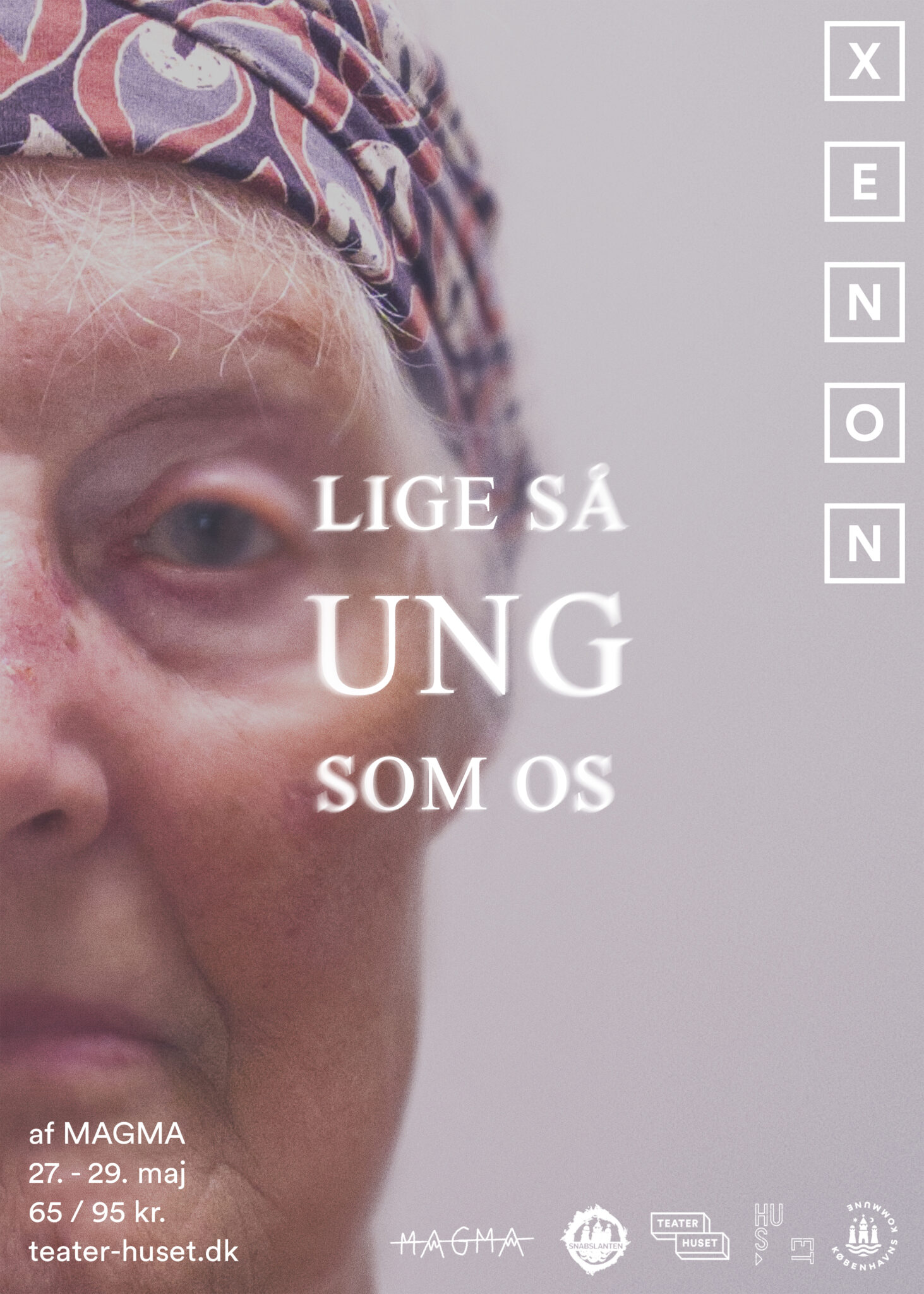
I will start with a little personal background information on this play. I am part of a small theatre company called MAGMA founded by my girlfriend.
When I’m part of these productions I naturally primarily do lights, and sometimes projection mapping. All through I am also tightly following the development of the narrative and the following promotion of the play.
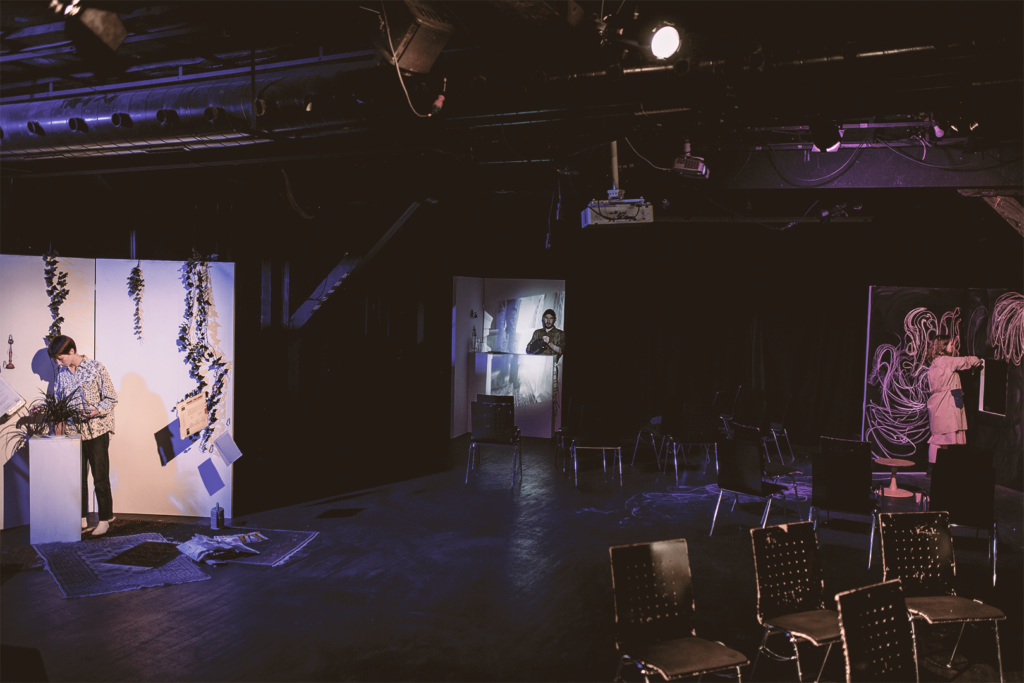
The play is performance installation where 4 actors have a booth each. The play is about the universal simularities in stages of live and the 4 young actors switch between playing “them selfes” and then an older person. Both characters they are playing is very directly based on interviews from the real people. The play it self could be interesting to analyze in relation to transmedia but I want to focus on the promotional material:
The videos feature the real life older people who are being represented in the theatre play. The young people are telling their stories about their yooth while also elaborating on their own lifes. But the fact that the promotional videos are expanding and giving context to main narrative that is the play, I would argue that this play actually can be defined as transmedia. The videos are posted on instagram as a way to promote the actual play, but these videos gives context, and actually expands the narrative in a way the play does not. In the videos the viewer actually gets to see moving images of the real characters the play is revolving around. You see flashes of their actual actual homes, and their appearance.
Furthermore, as Finn alludes to in his article when content is posted on the social media it indirectly encourages the viewer to interact with it, either through sharing it, or writing a comment.
While this theatre play is not a fully planned out transmedia experience, after what I have learned at Fontys it is clearer how you could expand the elements in a play like this to deliberately incorporate transmedia elements, not only into promotion but make it part of the core experience of the story.
As the story revolves around the lives of older people, a natural extension of the experience could be to actively nudge users on how to interact with the promotional material. The existing description of the posts on instagram, only mention where to buy tickets, but the description could instead encourage participation. One of the 7 principles of transmedia storytelling by Henry Jenkins. This refers to inviting the audience participate in extending the story.
So, in this example these posts could ask the viewer to share a story from the life of a grandparent and send it into the production. This could be possible through a form on a website, and these stories could then be presented either on the website, or maybe in the foyee of there the play is taking place. If you would like to take the futher, you could also make more shorter plays after this that centered around the user generated stories.
This is just 2 expamples, but through the 7 principles of storytelling, there is potenital to extend or revive concepts from already created creative artworks. It is also interesting to note that while this play was not delibriatly working on a transmedia projects, elements of transmedia was naturally incorporated in the marketing material.
The next section will bescribe the 7 principles of transmedia storytelling in order to better identify transmedia tools, used in other creative projects, either in the main story or as part of the marketing.
The 7 principles of Transmedia Storytelling
(Jenkins, 2010)
The 7 principles of transmedia storytelling are described by Henry Jenkins, in his blog and they present a good overview of elements that are commonly used in transmedia experiences.
Spreadability vs Drillability:
Spreadability refers to which opportunities the audience has to share the content and Drillability refers to how much the audience can “drill” into the details of the story to get more information. In the previous example, you could in order to make the story more drillable make a website that gives more backstory to the old characters of the play, just like the original promotional material does.
Immersion vs Extractability
Immersion refers to how the storyworld can be wrapped into the audiences envoirment. In the example of this theatre play, immersion is already used and incorporated intentionally. The audience is literally placed on the stage where the storyworld is unfolding and could in principle talk to the characters. Extractability refers to taking objects or elements from the storyworld and taking them into the real world. In the case of media franchisees this could refer to being able to buy a wand from Harry Potter.
Worldbuilding
Worldbuilding refers to establishing the rules and look of the world that the story is taking place in. The play is documentary based and because of this the storyworld is very similar to the rules of the the real world. As worldbuilding is an essential part of any narrative this is also taken into account in the play.
Seriality
This refers to considering on how to split up a narrative into multiple parts potentially on multiple platforms. In the case of the play I already suggested how to extend the concept, and make more plays around the same theme
Subjectivity
Subjectivity is about reflecting how transmedia gives the opportunity to tell the same story, from different perspective from different characters, even on different platforms.
In relation to the play subjectivity in the transmedia sense is not used, all though the concept of having different perspectives on the same narrative is actually present. In the play the young people playing the older peoples lifes also breaks character sometimes, and tell adjacent stories from their own lives. Here they also sometimes comment on the life and choices of the older character they are playing.
Performance
As stated earlier is about creating opportunities for the audience to contribute to the storyworld. Traditionally an example would be fan fiction mashups of existing content, like on TikTok etc. In the context of the play I suggested that the viewer could share stories of grandparents in while interacting with the promotional material.
Again, today it is all transmedia….
Looking at this play through the lens of these 7 principles it again becomes apparent that most media created in the modern world, are using transmedia.
Looking at this the point of Ed Fins article become even more clear. Here is an other excerpt from the article:
Just about every story we tell today is constructed using transmedia logics—unfolding across multiple platforms and channels, powered by digital technologies that enable diverse audiences to share a storyspace and an imagination space, making it their own. (Finn, 2024)
It is not by choice but it seems to have become second nature to think about the concepts in transmedia of creators, when producing content.
Example and small aside – David Dobrik on Youtube
While thinking about the omnipresence transmedia today, I thought of the Vlogs the youtuber David Dobrik creates, as an other example as transmedia as second nature. David creates vlogs about him and his friends that were very successful around 2016 – Link to Youtube channel
These videos are on the surface nothing revolutionary and are basically vlogs following the activities of him and his friends. But David works with transmedia elements through many different aspects of his As the content is online first through Youtube the spreadability is already built into the platform and the content, and as his vlogs are basically about his friends and him who are also social media personalities, the vlogs become “drillable” as the users can go to the channels of the people in the vlogs for deeper information of the main narrative of the vlogs. The world are also part of a storyworld with worldbuilding as the vlogs are documentary like, but they are also interjected with scripted skits, and through these, the friends become characters in the show, more than they are real people, not performing. At their peak the vlogs came out every Wednesday like a TV show, and through this the vlogs achieve seriality. But the most interesting part of the vlogs is how subjectivity naturally emerged because of the vlogs popularity. Because the friend group of the vlogs and many of them lived together the other members began to post their own videos from the same days the vlogs took place at. As a result, if you also watched the videos from other members you got to see the events of the main narrative (David Vlogs) from the other “characters” perspective.
As a conclusion this is an other example of modern media becoming transmedia without it being a deliberate effort.
Transmedia elements are everywhere – But not deliberately
In relation to this the introduction to this vision document reflected on the “usefulness” of the term transmedia now that you could argue that all media now has elements of transmedia in it.
In the the paper “Transmedia Brand Storytelling” the authors interviewed working professionals and their relationship to transmedia.
Many professionals engage with transmedia storytelling in their daily work, even if they don’t explicitly use the term. As one senior creative from the UK explains:
“We don’t use the word transmedia, but it’s something we do in our jobs every day. To be able to speak to a customer, you need to be able to tell the same story across many different platforms.”
Other practitioners describe how transmedia concepts emerge organically, rather than following a specific industry model. A creative director from Canada reflects on this approach:
“It wasn’t anybody’s intention to ‘create a transmedia campaign.’ Nobody was even using the language. We were just looking for a really different approach and a different way of getting people interested and excited.”
Some professionals see transmedia storytelling as interchangeable with integrated marketing communication (IMC) or 360-degree campaigns, as illustrated by the following insights:
“When I talk about transmedia, or what we call integrated planning, we look at storytelling as the ability to spread a centralized idea.”
— Lead Planner, Australia
“I would describe transmedia storytelling as an integrated marketing campaign that is centered around content, tells a brand story, has a point of view, and expresses brand values.”
— Brand Manager, Canada
Blurring the Lines Between PR, Advertising, and Content
While some practitioners avoid the term “transmedia,” they recognize its role in a convergent media landscape that blends PR, advertising, and content:
“[Transmedia storytelling is] using a diverse mix of channels—especially digital and traditional media—to get our brand story out there.”
— PR Director, Canada
Audience-Centric Storytelling
Many see transmedia as an evolution of brand storytelling rather than a separate discipline. This evolution emphasizes audience engagement:
“We think [transmedia storytelling] is a tool we can leverage to put people at the center of the story and say, ‘You have the power to influence the people immediately around you.’”
— Communications Manager, Australia
For some, transmedia storytelling is simply the way storytelling exists today rather than a distinct methodology:
“There’s not a separate transmedia type of storytelling. It’s actually the storytelling that exists today.”
— Mixed Reality Agency CEO, US
The Role of Audience Participation
While transmedia emphasizes audience engagement, practitioners rarely highlight user-generated content or interactive brand experiences in their initial descriptions. However, the increasing role of audience participation continues to shape the future of transmedia branding. (Sutherland & Barker, 2023)
These quotes from different companies working in marketing also show how transmedia is integrated in branding strategies and content creation. None of them actually use the term transmedia but they all work with transmedia tools. The term it self just does not seem to be that useful as a communication tool.
This paper and these quotes about transmedia is not meant to be negative towards transmedia, only to show, that because many elements of transmedia has become so universal that they are hard to talk about.
The next section will continue to reflect on personal projects and the transmedia elements within them:
Interactive Experience – MegaCorp
I would now like to introduce an other project, this time produced and executed by me. Through the lens of Transmedia analysis established earlier, this production is interesting to take a look at, as it has a lot of moving parts and utilises different platforms.
MegaCorp is an interactive experience developed while studying at Film and Transmedia, that aims to give its audience a bigger awareness of how important privacy can be, and also aims to educate the user.
This experience can be divided into three stages:
- Welcoming
- Entering the room
- Off-boarding and learning experience
The main reason I thought it would be interesting to look at this experience a through the lens of transmedia is that I after having studied at Fontys become a little doubtful that this actually qualifies as a transmedia experience, even through I was reasonably sure before hand.
The experience starts when you walk into the waiting room. You are greeted by 2 employees who thanks you for coming, and then asks you to sit in the waiting sofa. While you wait, an infomercial about the services of megacorp is playing on the TV. When its your turn, you are sat a computer and asked to put in basic info about yourself, and then you enter the assement room. In the assessment you are asked questions about privacy which answer by pushing buttons.
You then leave the room and 5 minutes later the robot has sent you SMS messages with tips on how to improve your own privacy.
The production has high immersion as the theatre play is literally wrapped around the audience when you are in the projection room. The first stage of the experience a greeting from employees and then waiting room. The waiting room acts as vehicle for word building through the powerpoint on the screen in front of you, that tells you about the company and the machine that will conduct the survey.
There is also elements of performance – as the audience are asked to put in personal information that personalises and changes the experience based on the user. There are also elements taking spreadabilty into account as when the user leaves, they receieve SMS messages that they can show or send to other people encouraging them to also go to the event, or maybe just change their habits around privacy.
While this project has many elements of transmedia storytelling and also different parts of the story being onfolded via different medias such as acting, and projectionmapping I have concluded that it is not a transmedia project, because of the definitions established in the intro of the document. While the tools of transmedia are being used, it fits better under the definition of a multi-media project from earlier.
The Hackathon – Plantagotchi
Together with other classmates at Fontys I attended a hackathon. The goal of the hackathon in my case was to develop a product that could give nature a voice through new AI technology developed by a sustainability focused company. The pitch of our product went very well and after reflecting on the idea creation of the product we ended up with I have realised how many transmedia like tools, we used when developing the product.
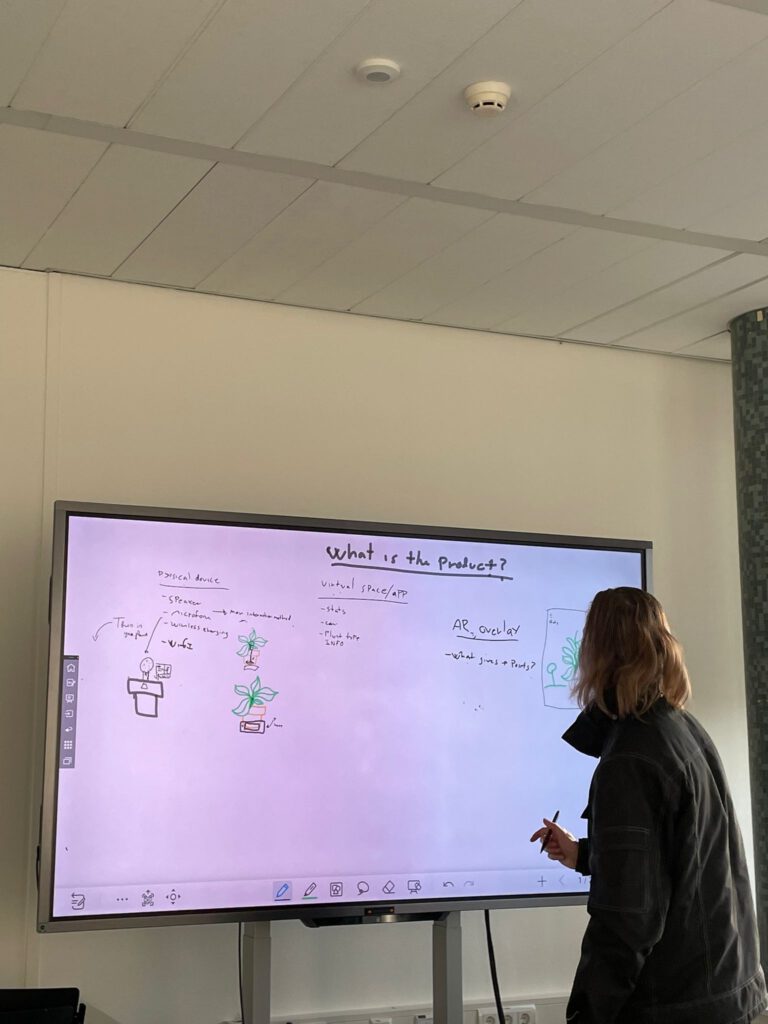
The product we ended up creating was a device you could put into your houseplant that would equipped with sensors, that would monitor your plants well being, and then the user could also set up a personality for its plant, and finally the plant could talk to you through the AI system provided by the company that made the pitch. This was the most basic part of the idea. Taking your plant that existed in the real world and extended its capabilities so it became a character. In relation to transmedia you could look at the plant as a character in a storyworld mimicking real life, through mechanisms of extractability.
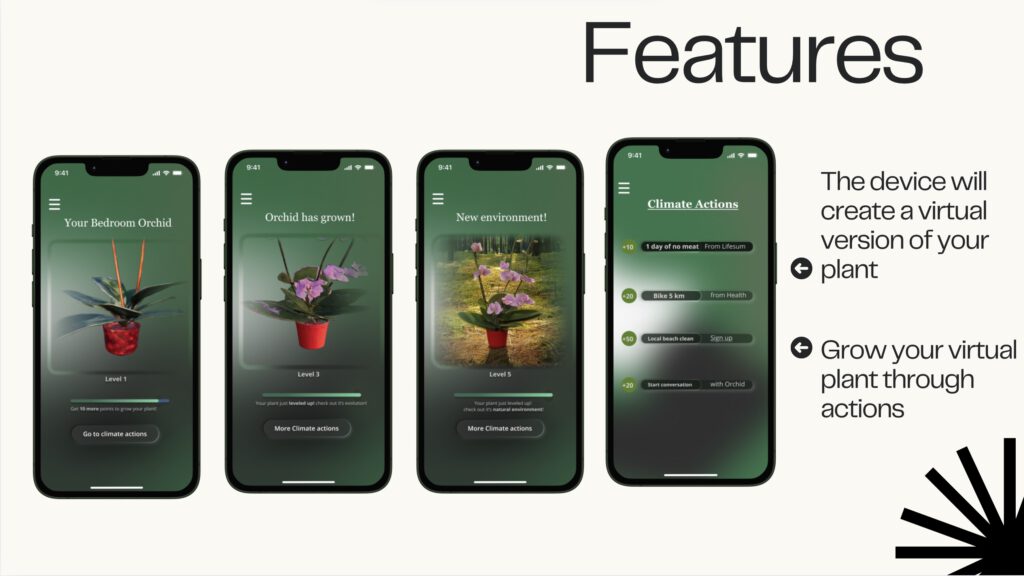
The second part of the product was the app, that through cameras on the device created a virtual version of your houseplant at home which you could nurture on the app. Here we take the physical version of the plant, and moves a representation of it to an other platform, so you could say, that this also has elements of transmedia. In transmedia you often talk of remediation of media, which involves taking an original text and adapting to an other platform to retell or tweak the story.
In a blog post by Henry Jenkins, he interviews Richard Grusin, who together with others defined the remediation:
HJ: Yes, depending on how broadly or narrowly we define transmedia. I have made the argument that the church in the middle ages was profoundly transmedia if you lacked the capacity to read. For the priests, the Bible stories were rooted in a text and everything else would have been understood as an illustration of that text. But if you couldn’t read that text, you were absorbing bits of the stories from many different sources in the culture around you and the stories could be brought together via stainglass windows, tapestries, or paintings, where characters from multiple stories or symbols for many parables might exist side by side. Michelangelo is in that sense a profoundly intertextual artist. (Jenkins, 2011)
Based on this broad definition, I feel comfortable using the term in this context as well. In the case of this product development process we used technology to extend the capabilities of a real life object to make it possible to be a character, with a personality that could be placed within a story. Afterwards we used modern AI 3D scanning technology to scan the plant and actually remediate the and recontextualize the plant into a digital world.
Plantagotchi’s main product pitch is the scanning of the plant, that then gamifies your relationship to your plant and turns it into a digital pet such as a tamagotchi.
In conclusion, here again, even though this experience I had nothing directly to do with developing a transmedia experience I still ended up having great use of the tools I have learned while working with transmedia.
Conclusion – How I will use transmedia in the future
In order to have a framework to explain how I think Transmedia could be useful to me in future projects I would like to present an experimental project I did together with a danish actor right before coming to Fontys. The goals of the projects were very open ended and was more of a test than a finished project but we both agreed that we would like develop it further.
Camboy – An exploration of Only Fans as a platform
An middle aged actor approached me originally in order to get help with understanding different content platforms on the internet and the incentive structures within them. His goal was to create a auto-fictional narrative on onlyfans revolving around a character based on himself. A white middleaged heterosexual man, joining onlyfans due to desperation and the need to be acknowledged. This became the project Cam-Boy. Through OnlyFans the actor Peter would be live-streaming everyday for a month, and during these live-streams he would sell parts of his own life. Instead of selling nakedness, or directly selling his body Peter would sell almost everything else. Through donations the audience could buy personal embarrassing stories, intimate talks with Peter, or control the music Peter was listening to.
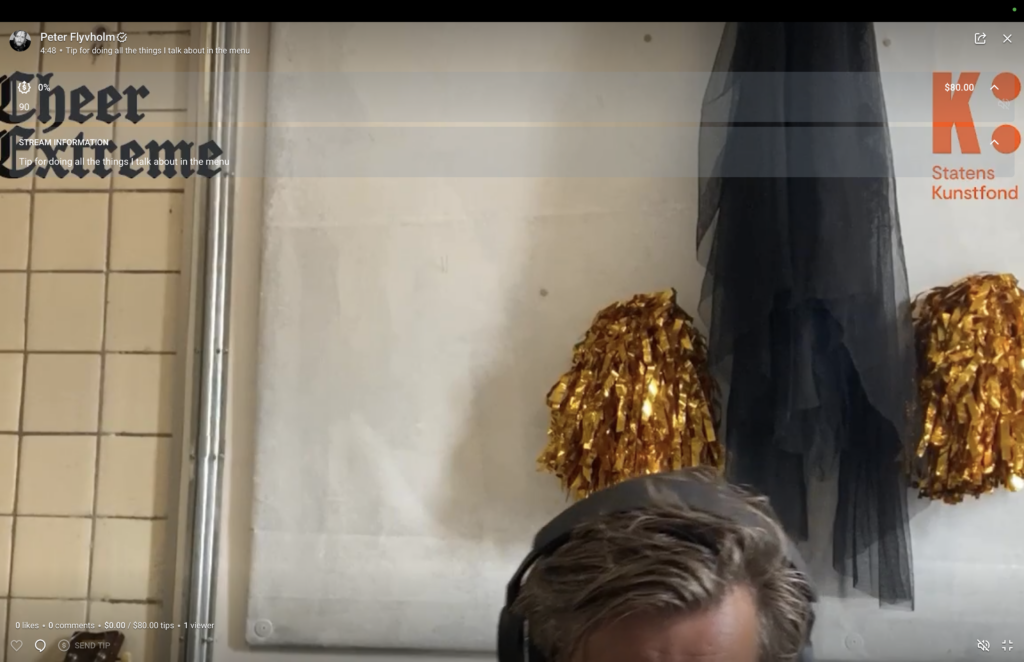
All though preproduction talks we had a lot of talks about the concept and specifically platform Only Fans and its mechanism. Onlyfans is different from most other “social media platforms” in the way of, it having no built in discovery features. Because of this I warned Peter that this project would need to be promoted through other social media platforms as well in order to have any kind of reach. Furthermore there were discussions about how difficult doing the project on onlyfans would make it for the audience to engage with it. As OF primarily is a site to sell explicit material it is still quite taboo, to be on and Only Fans has other mechanisms as well that make it hard to be a casual viewer. In order to just view a page on the platform the user will need to register an account, and to make an account you will need to add your credit card details. This creates enormous friction for the user to engage and related to this, it also completely kills any spreadability. Because of this, even though we were aware of it when started the project, the project and live stream never had any organic viewers.
In this case this was okay as it was expected and the project was intended as an experiment and a way to create footage for further development. For me, this is where all of the tools of transmedia I have leaned about throughout this minor comes in. In the initial talks about the project it was always the plan to do more with the generated material after the live stream sessions. The original intension was to use the material to create a theatre play. But through the tools of transmedia I see an opportunity to revive this concept when coming back to my home country and develop this project into a Transmedia project through remediation and the tools I have become better at using while at fontys.
Extending the life of old material with Transmedia
First I would like to use this material and relaunch the themes and message of the project by working the material into a short form mockumentary series released through instagram. This would be a good way to use make use of the old material and a good starting point for establishing the characters traits within a storyworld. To release it as a short series also has the benefit of using seriality, and the shortness of the episodes takes the affordances of a platform such as instagram into account. As the original idea was to develop the project into a theatre play, this would be what the other elements of the story would lead into.
The mockumentary could be the first thing to release as could also function as promotional material for the theatre play. The basic idea would be:
- The mockumentary – OnlyFans gone bad
In the mockumentary you could follow Peter sharing his motivations and telling about the parts of his life that lead up to his decision to launch an onlyfans. The original material could be presented as being created real time as the episodes comes out and then the story of the mockumentary would act as a behind the scenes from specific days of live streaming. The story that unfolds would then be a story of a man, getting more and more disillusioned with the project and the premise would be a tragic narrative.
- A small performance in the real world
As the story progresses and gets more and more desperate about getting followers, Peter could setup his stream in a public space and plead with people about joining his onlyfans. This would function as a small extension that underlines Peters misery.
- The Play – About the experience
The last element of the transmedia experience would be a continuation of the story after Peter has hit rock bottom, and could be a retrospective retelling of the events in the mockumentary in an other format. In the play Peter the narrative framing would be Peter guiding the audience through the whole experience of deciding to open an Only Fans and follow him untill now where the project failed, and he now is performing a play about the experience.
Reflection on what I have learned – Vision statement
To make this experience a full transmedia experience, the concept would of course need to developed in more detail but this exercise has helped me a lot with identifying the use of transmedia tools across all of my projects. As alluded to earlier I see transmedia as a tool for my self to revive old projects and ideas, and give them new life, without starting over. At the start of this minor I was unsure of what defines transmedia, but more importantly how it could be relevant for me even when not working directly on a transmedia project. My worry about transmedia has always been that to be able to work on a pure transmedia project is very rare, and because of this I was unsure how useful learning more about how to produce transmedia.
But what I have learned through this minor, and writing this vision document is that many professionals are using the tools of transmedia when coming up with ideas, and planning projects regardless of if the core product is an actual transmedia project.
Overall what i’m taking home after this is how I can use the transmedia way of thinking and producing content is highly relevant for me in the fields I work in. Initially I was sceptical of transmedia, but this opportunity to dive further into the craftmanship of producing has given me a lot of useful tools for all of my future projects.
References
Jenkins, H. (2007, March 22). Transmedia storytelling 101. Henry Jenkins. https://henryjenkins.org/blog/2007/03/transmedia_storytelling_101.html
Højer, M., & Linnebjerg, M. W. (Eds.). (2017). Det nye mediefag: Et inspirationsmateriale. Medielærerforeningen. https://cutmagazine.dk/wp-content/uploads/2024/06/Det-Nye-Mediefag.pdf
Finn, E. (2024, April 22). It’s all transmedia now. Henry Jenkins. https://henryjenkins.org/blog/2024/4/17/its-all-transmedia-now
Møller, K. H. (Director). (2021). Lige så ung som os [Theatrical performance]. Teaterkollektivet MAGMA.
Sutherland, K. E., & Barker, R. (2023). Transmedia brand storytelling: Immersive experiences from theory to practice. Palgrave Macmillan.
Jenkins, H. (2011, March 10). A remediated, premediated, and transmediated conversation with Richard Grusin (Part Three). Henry Jenkins. https://henryjenkins.org/blog/2011/03/a_remediated_premediated_and_t_2.html